









Business Strategy with Hirav Shah
Most business owners don’t fail because of lack of effort. They fail because of poor time allocation. They spend too much time “running” the business and almost none on “growing” or “transforming” it. This is where the 70-20-10 formula becomes practical.
It is a simple framework:
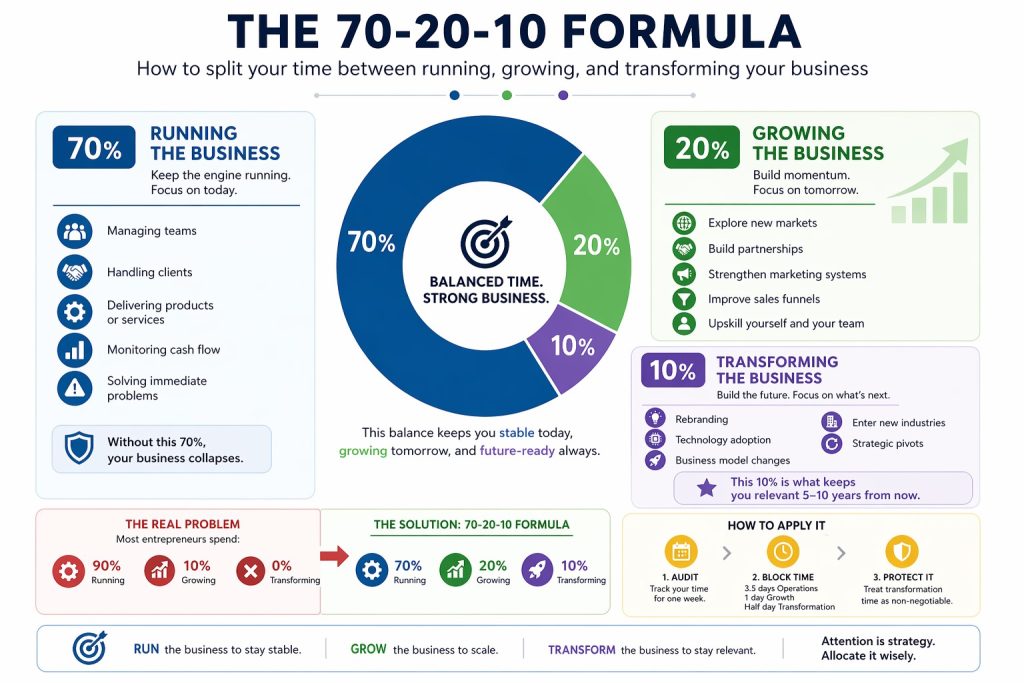
70% time on running, 20% on growing, and 10% on transforming.
Let’s break this down in a structured way.
What does 70% “Running the Business” actually mean?
This is your operational zone. The daily engine.
It includes:
- Managing teams
- Handling clients
- Delivering products or services
- Monitoring cash flow
- Solving immediate problems
Without this 70%, your business collapses. But here is the risk: most entrepreneurs get stuck here permanently.
As Hirav Shah often emphasizes, “Execution keeps the business alive, but it does not guarantee growth.”
If you spend 90–100% of your time here, you are not building a business. You are maintaining a system.
Why 20% must go into “Growing the Business”
Growth is not automatic. It is intentional.
This 20% is where you:
- Explore new markets
- Build partnerships
- Strengthen marketing systems
- Improve sales funnels
- Upskill yourself and your team
This is where strategy meets expansion.
Most businesses stagnate because they treat growth as “extra work” instead of “core responsibility.” But in reality, growth is what protects you from competition.
Think of it this way:
Running keeps revenue stable.
Growth increases revenue potential.
Without this 20%, your business becomes predictable—and predictable businesses are easy to disrupt.
The most ignored 10% — “Transforming the Business”
This is the highest leverage zone, yet the most neglected.
Transformation includes:
- Rebranding
- Business model changes
- Technology adoption
- Entering new industries
- Strategic pivots
This is where future relevance is built.
Many leaders avoid this 10% because it feels uncomfortable. It requires thinking beyond current success. But this is exactly where breakthroughs happen.
Again, from a strategic lens often highlighted by Hirav Shah:
“Businesses don’t fail suddenly. They become irrelevant slowly—because transformation was ignored.”
That 10% is what decides whether you will still matter 5 years from now.
The Real Problem: Misallocation of Time
In real scenarios, most entrepreneurs operate like this:
- 90% Running
- 10% Growth
- 0% Transformation
This creates:
- Burnout
- Plateaued revenue
- No innovation
- High dependency on the founder
The 70-20-10 formula corrects this imbalance.
What the 70-20-10 Formula Looks Like in Real Life
Imagine a business owner working 60 hours every week. Nearly 50 hours are spent reviewing routine work, approving small expenses, answering staff questions, handling customer complaints, and following up on payments. By the end of the week, the owner is exhausted but has made little progress toward the company’s future.
The problem is not a shortage of time. It is a lack of delegation and priority.
Under the 70-20-10 formula, the owner would gradually delegate repetitive operational work to responsible team members. This would create time for reviewing new sales opportunities, improving customer retention, developing partnerships, studying competitors, and exploring technology that could make the business more efficient.
The formula should also be adjusted according to the stage of the business. During a crisis or peak season, running the business may temporarily require more than 70% of your attention. During a major expansion or rebranding exercise, growth and transformation may require a larger share. The objective is not to follow the percentages mechanically, but to ensure that none of the three areas is consistently ignored.
A useful monthly question is:
“What did I do this month to run the present, grow the next, and create the future?”
If you cannot identify meaningful action in all three areas, your time allocation needs correction.
How to Apply This Practically
You don’t need to change everything overnight. Start with structure.
Step 1: Audit your current time
Track one week honestly. Where is your time going?
Step 2: Block time intentionally
- 3.5 days → operations
- 1 day → growth
- Half day → transformation
Step 3: Protect transformation time
This is not optional. Treat it like a board meeting with your future.
Final Perspective
The formula is not about rigid percentages. It is about disciplined thinking.
If you only run the business, you stay busy.
If you grow the business, you scale.
If you transform the business, you stay relevant.
The difference between average businesses and category leaders is not effort. It is how they allocate their attention.
And in business, attention is strategy.
Hirav Shah is the Global Business Strategist, Game Changer, and Author of 19+ books—trusted worldwide for validating big decisions of entrepreneurs, sportsmen, and entertainers.
Email: [email protected]