








New Yorkers and visitors urged to text SUMMER26 to 692-692 to receive emergency alerts and updates on summer events
Our Bureau
New York, NY
Mayor Zohran Kwame Mamdani and Governor Kathy Hochul have outlined sweeping multiagency plans to keep New Yorkers and visitors safe, informed and moving throughout the 2026 FIFA World Cup™. Today’s briefing focused on transportation, infrastructure and emergency preparedness. An additional public safety briefing will be held next week to detail the City’s plans to ensure a safe and successful tournament.
“We have spent months coordinating, drilling and preparing so that when the world arrives at our doorstep, we are ready,” said Mayor Mamdani. “From the first kickoff to the final whistle and long after, our job is clear: keep residents and visiting fans safe, informed and supported during every moment of this busy summer.”
“New York’s transit system safely and reliably moves millions every day, and we are ready to shine on the world stage,” said Governor Hochul. “The World Cup will be a once-in-a-generation event for our state, and whether you’re traveling from Brazil or Bed-Stuy, we have a plan to get you to where you need to go safely.”
“After months of planning, we are adding trains wherever fans are going to watch matches while helping to keep them safe,” said MTA Chair and CEO Janno Lieber. “Moving millions is what we do, and not just when the World Cup is in town.”
“With kickoff just days away, our region is ready to welcome the world. This level of preparation doesn’t happen overnight — it is the result of years of collaboration among transportation agencies, public safety officials and government partners across New York and New Jersey,” said NYNJ Host Committee CEO Alex Lasry. “Thanks to the leadership of Governor Hochul, Mayor Mamdani, the MTA and countless partners, fans will have safe and reliable ways to travel throughout the tournament while residents continue to move around the region. We are grateful for their partnership and shared commitment to delivering an unforgettable World Cup this summer.”
Interagency Transportation Planning
The City and State are coordinating with the NYNJ Host Committee, Metropolitan Transportation Authority (MTA), NJ TRANSIT and the Port Authority of New York and New Jersey (PANYNJ) to direct World Cup-related traffic through designated Midtown Manhattan corridors, helping fans travel to and from matches while minimizing disruptions for New Yorkers.
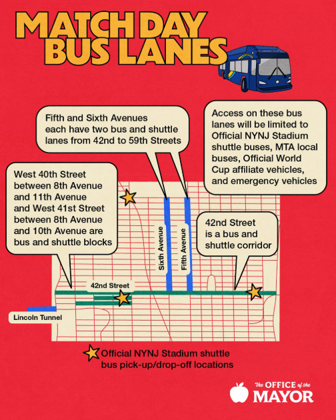
On match days, dedicated travel corridors will operate along 42nd Street and portions of Fifth and Sixth avenues and 40th and 41st streets. Beginning six hours before kickoff and ending three hours after the final whistle, access will be limited to NYNJ Stadium shuttles, MTA local buses, official World Cup vehicles and emergency response vehicles.
The City will also designate each match day a “Gridlock Alert Day” to discourage unnecessary driving, work with businesses to limit truck deliveries in Midtown during peak travel periods and encourage both residents and visitors to use public transportation.
NYC DOT will deploy more than 100 staff members throughout Midtown to manage traffic operations. Personnel will coordinate transportation logistics with FIFA, inspect routes, install and remove temporary bus lanes, adjust signal timing in real time and provide travel guidance to the public, drivers, the trucking industry and local businesses.
The MTA plans to run full service throughout the region on all match days and throughout the tournament to support visitors to the region and the millions of New Yorkers who rely on mass transit to get around every single day.
The MTA will run extra subway service on match days and fully scheduled commuter rail service at both Penn Station and Grand Central on both its railroads to ensure that the region continues to move.
NYC Emergency Management (NYCEM) has activated a unified citywide coordination structure — including the City’s Emergency Operations Center — that will expand as the tournament approaches and in response to severe weather events such as extreme heat and flash flooding.
Built on the same Citywide Incident Management System used for hurricanes, blackouts, the Macy’s Thanksgiving Day Parade and New Year’s Eve celebrations in Times Square, the framework brings together hundreds of City, State, federal and private-sector partners under shared objectives.
The NYC Department of Health and Mental Hygiene (DOHMH) and NYC Health + Hospitals have spent the past year conducting tabletop exercises and multiagency drills — including a weeklong simulation involving medical demand exceeding capacity — to strengthen preparedness across the city’s health care system.
Both agencies have activated the Incident Command System to enhance coordination with NYCEM, FDNY and health care partners. They are collaborating on disease surveillance efforts to rapidly detect and respond to infectious disease threats.
NYC Health + Hospitals has established a Special Pathogen Response Team for high-consequence incidents, while its Office of Biopreparedness and Emergency Management has led operational planning efforts to strengthen readiness and train staff on best practices.